
10DLC Registration Guide
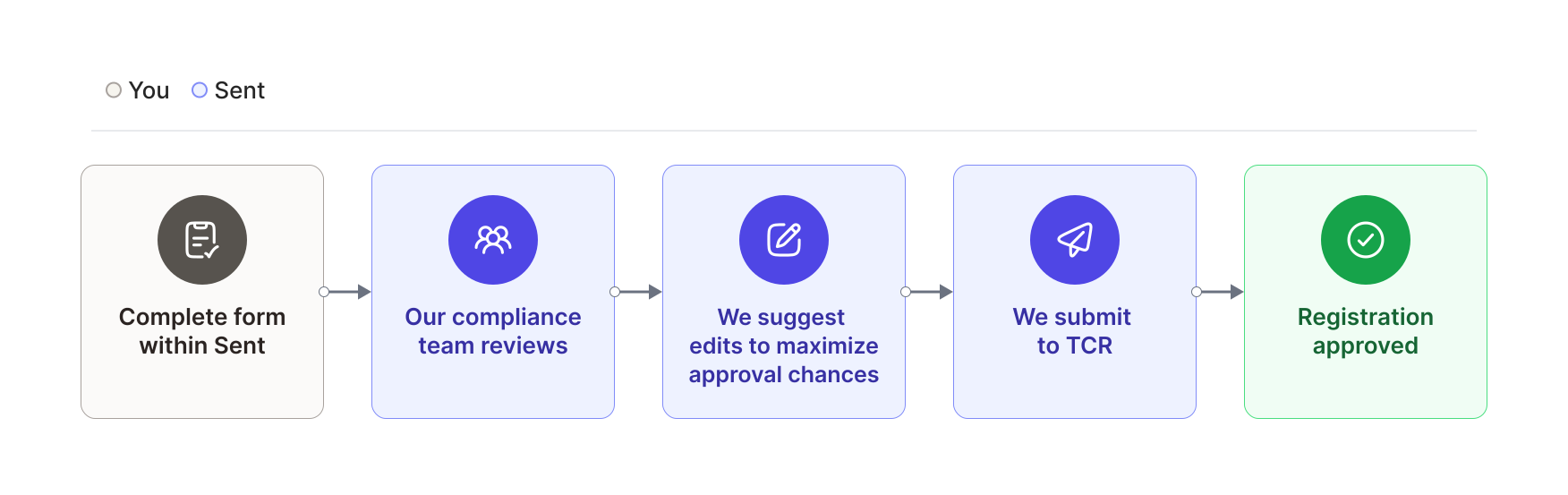
TL;DR: To send SMS to US numbers, you need to register your business and messaging use cases. Sent handles the submission on your behalf. You fill out the form in our platform, our compliance team reviews it, and we submit to TCR. Most approvals take 1–3 business days.
This guide shows you how to register for 10DLC through the Sent dashboard: where to start, which campaign type to pick, and what to put in each part of the form so it passes review. If you are new to 10DLC, or you want to understand why US carriers require registration and how the review works, read What is 10DLC? first. To register many brands programmatically, see Register 10DLC Campaigns via the API.
Applying through Sent
Step-by-step guide to completing your 10DLC brand and campaign registration for compliant SMS messaging in the US.
Playlist
Fill out the form
In the Sent dashboard, go to Compliance and select Apply on the US 10DLC notice, or open the 10DLC registration form directly. Submit your business and campaign details; the form collects everything TCR requires, and the sections below cover what to enter in each part.
Compliance review
Our compliance team reviews your submission and gives you feedback to maximize your chances of approval before it reaches TCR.
TCR submission
We submit your registration to TCR on your behalf.
Approval tracking
We track the review and notify you when you're approved, or if anything needs fixing.
Most submissions come back approved within 1–3 business days.
If your submission is rejected, the Sent compliance team reviews it and gives you specific steps for resubmission. All Sent customers (including those who haven't sent any messages yet) get compliance support throughout this process.
Choosing the right campaign type
Pick the use cases that reflect what you're actually sending. Don't try to game this: carriers flag mismatches between your registered use case and your actual messages.
| Use case | When to use |
|---|---|
| Marketing | Promotional offers, discounts, announcements |
| Customer care | Support conversations, ticket updates |
| 2FA / OTP | One-time passcodes, login verification |
| Account notifications | Password resets, balance alerts |
| Appointment reminders | Booking confirmations, schedule changes |
| Delivery notifications | Order shipped, out for delivery |
| Fraud alerts | Suspicious activity notices |
If you have multiple use cases, a mixed-use campaign covers them all under one brand. For smaller senders, low-volume mixed offers the same flexibility with a cap of 2,000 messages per day. This is usually what Sent recommends for growing businesses and startups.
TCR fees
TCR charges pass-through fees for campaign registration. Sent waives the first 12 months of these fees.
| Campaign type | TCR fee |
|---|---|
| Low-volume mixed | $1.50/month |
| Standard / high-volume | $10.00/month |
These are TCR's fees, not Sent's. Sent charges its own campaign fee on top of them, and the 12-month waiver covers only the TCR pass-through fees. Sent's fee depends on the volume tier you pick and is billed on its own schedule, which is not always monthly.
You see the exact amount and billing period for your tier in the dashboard when you register the campaign, before you confirm. Check there rather than budgeting from this table.
What goes into your submission
Brand name
Brand name matters. This field should not be your official legal name. It should be how your customers actually know you. If your LLC is registered as "Kevin's Donuts LLC" but your website and receipts say "Kevin's Donuts," use the latter. That's what appears in messages to your customers and needs to match what they'd recognize.
Campaign description
Keep this short: one or two sentences covering who's sending, what they're sending, and why.
Opt-in method
You need to document how you get consent from people before texting them. TCR calls this your message flow.
Someone fills out a form on your site. You provide the URL and describe how they get there. The form itself has its own requirements (see below).
Gathered over the phone or in person. Document the script used, where the contact info is published, and whether it's phone or in-person. Marketing use cases require double opt-in if consent is spoken.
You publish a number and keyword, and subscribers text it to opt in. Best practice is to display the full disclaimer wherever you publish the number.
A physical form collected during an in-person visit, with a hosted screenshot submitted as documentation.
Opt-in form requirements
If your 10DLC keeps getting rejected, the form is usually why. Carriers are strict about explicit consent: missing even one element is enough to fail.
If you're using a web or paper form, it needs all of the following, clearly visible before the user hits submit (not buried in fine print):
-
Program name: make it clear who is texting them and what the program is
-
Message frequency: something concrete, like "Max 4 msgs/month," not "frequency may vary"
-
Cost warning: "Msg & data rates may apply"
-
Opt-out info: "Reply STOP to opt out" or "Text STOP to cancel"
-
Legal links: direct links to your Privacy Policy and Terms of Service
-
Full disclaimer (or equivalent):
You are opting in to receive [message types] from [Brand]. Msg and data rates may apply. Msg frequency may vary. Reply HELP for help or STOP to opt out. No mobile information will be sold or shared with third parties for promotional or marketing purposes.
-
SMS consent is voluntary, distinct, and explicit, typically an unchecked optional checkbox
-
The checkbox cannot be pre-checked
For marketing campaigns, the language should make clear the messages are promotional. For charity or political campaigns, note whether donations will be solicited.
Autoresponse requirements
Every 10DLC campaign needs three documented autoresponses. Each has required elements.
Triggered by START or a related keyword. Must include:
- Brand name
- Reply HELP for help
- Reply STOP to opt out
- Msg and data rates may apply
- Msg frequency may vary
Example:
[Brand]: Welcome! Please reply HELP for help. Message frequency may vary.
Msg & data rates may apply. Reply STOP to opt out.
Triggered by STOP or related keywords. Must include:
- Brand name
- Unsubscription confirmation
- Notice that no more messages will be sent
Example:
[Brand]: You have been unsubscribed and will not receive more messages.Triggered by HELP or related keywords. Must include:
- Brand name
- An email, toll-free number, or URL where support can be reached
Example:
[Brand]: Please contact us at [email / toll-free number / URL] for support.Sample messages
For each use case you select, submit at least one sample message. Mixed and marketing use cases require two. Every sample must include the brand name and look like a real message.
| Use case | Example |
|---|---|
| Marketing | [Brand]: Thanks for opting in! Use code DISCOUNT20 for 20% off through the end of the month. |
| Account notification | [Brand]: Your password has been reset. |
| 2FA | [Brand]: Your code is 123456. |
| Customer care | [Brand]: Thanks for your message! We'll be right with you. |
| Delivery notification | [Brand]: Your order has been delivered. |
| Fraud alert | [Brand]: We noticed a suspicious transaction. Log in or call us to complete it. |
You can update sample messages later. What you cannot do later is send messages that fall outside your registered use cases.
Agencies and resellers
If you're sending on behalf of clients, each business needs its own campaign registration. You can't bundle clients under a single campaign: TCR ties campaigns to the business actually responsible for the messages.
You can submit registrations manually for each client through the dashboard. If you're managing multiple brands, collect the required information within your platform and submit programmatically; Register 10DLC Campaigns via the API covers the endpoints and bulk registration patterns.
If you get stuck
10DLC registration is a one-time requirement for each brand you send from. If a form field is unclear or your submission is rejected and the resubmission steps don't resolve it, email support@sent.dm; the support team typically responds within 1 business day. For errors that appear after approval, see Compliance & 10DLC Issues.
Performance optimization: high throughput on the Sent API
Optimize Sent API throughput: stay under the 10,000 requests per minute rate limit, batch up to 1,000 recipients per request, cache reads, and queue sends.
Register 10DLC Campaigns via the API
Create, track, update, and delete 10DLC campaigns with the Sent API, from SENT_CREATED to ACTIVE, plus bulk registration patterns for agencies and resellers.